Novas
What Is Sintered Stone? Benefits, Properties, and Uses

Sintered stone combines a compact mineral structure with controlled surface design. Its value becomes clearer when performance, finish, thickness, fabrication, and installation are considered together. This guide briefly explains how the material is made before focusing on its practical advantages and appropriate architectural uses.
How Is Sintered Stone Made?
Production starts with mineral raw materials that are ground, blended, and prepared to achieve a consistent particle distribution. The mixture is then compacted under pressure. Uniform compaction matters because variations inside the body can affect flatness, strength, cutting behavior, and firing stability.
High-temperature firing bonds the compacted particles into a solid structure. Decoration and finishing are added according to the required design. Digital printing can reproduce stone-inspired veining, abstract graphics, and customized patterns, while polishing or surface texturing creates different visual and tactile effects.
At Guanyu Ceramics, our available product information includes UV-printed sintered stone with a 6 mm profile and customizable digital graphics. Pantone-based color matching can also be used for project-specific decorative development. These capabilities are particularly relevant when a buyer needs a surface to follow an interior concept rather than select an existing pattern.
Why Sintered Stone Performs Well in Surface Applications
Low Porosity Supports Easier Surface Care
A dense body limits the space available for liquids to enter the material. This can improve resistance to moisture and common surface stains while simplifying regular cleaning. The actual result still depends on the selected finish, exposure conditions, joint design, and cleaning method.
Low porosity does not mean that every substance can remain on the surface indefinitely. Oil, pigments, grout residue, and construction chemicals should still be removed promptly with cleaning products approved for the relevant finish.
Scratch Resistance Helps Preserve the Finish
A hard mineral surface can withstand routine contact better than many softer decorative materials. This is valuable for surfaces that may encounter moving objects, cleaning tools, or frequent handling.
Heat and Fire Performance Expand Design Options
The high-temperature manufacturing process gives the material a mineral-based structure that can perform well around heat when the correct product is selected.
Fire performance must be connected to a defined classification and test report. A general fire-resistant statement does not automatically establish suitability for a wall assembly, escape route, fireplace surround, or regulated commercial interior. The substrate, adhesive, joints, and fixing system can all affect the completed installation.
Thin Formats Reduce Visual Weight
A 6 mm format can create a refined surface without the visual mass of a thick stone section. It can be useful for wall finishes, decorative panels, furniture facing, and other supported applications where reduced thickness is part of the design requirement.
Thin does not mean that handling rules can be ignored. Edges remain vulnerable during lifting, transport, cutting, and installation. Full support, appropriate tools, controlled feed rates, and suitable adhesive coverage are essential. Technical processing guidance for sintered stone also emphasizes correct cutting, drilling, handling, and support procedures.

Matching Properties to Applications
| Aplicação | Main Advantage | Specification Priority |
| Interior feature walls | Printed patterns and reduced visual joints | Substrate, fixing method, pattern layout, edge detail |
| Interior floors | Dense body and wear-resistant surface options | Slip resistance, abrasion data, traffic level, joint design |
| Furniture facing | Thin profile and coordinated finish | Structural support, edge processing, hardware positions |
| Table and work surfaces | Stain, scratch, and heat resistance | Cut-outs, edge protection, support, cleaning requirements |
| Customized decorative panels | Digital graphics and color control | Artwork quality, sample approval, batch consistency |
Interior Feature Walls
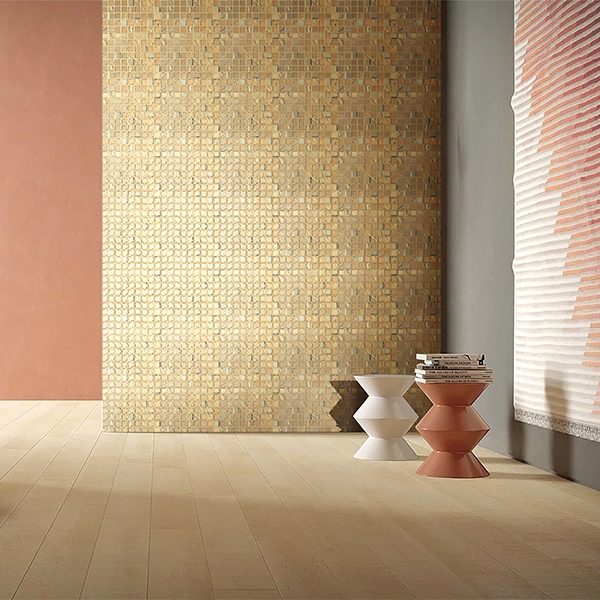
Feature walls are one of the clearest uses for customized sintered stone. A printed surface can introduce marble-inspired movement, geometric graphics, or large abstract artwork without relying on wallpaper or multiple small decorative units. Guanyu Ceramics’ knowledge base presents a UV-printed 6 mm feature wall as a representative application.
Pattern planning should take place before cutting. The project team needs to confirm the visible area, pattern direction, joint positions, outlet locations, corners, and lighting. These details determine whether the finished wall reads as one coordinated composition.
Interior Floors
Floor applications require more than a suitable color. The selected product must match expected foot traffic, cleaning procedures, abrasion exposure, and wet or dry conditions. Slip performance is particularly important in entrances, bathrooms, commercial circulation areas, and other locations where moisture may reach the floor.
Large formats can reduce the number of visible joints, but they increase the importance of substrate flatness and adhesive coverage. Movement joints cannot be removed simply to create a more continuous appearance. The installation system must accommodate expected structural and thermal movement.
Furniture and Cabinet Surfaces
Thin sintered stone can be integrated into furniture fronts, cabinet panels, tabletops, and other supported surfaces. Its value lies in combining a mineral finish with controlled pattern and color options. It can also help designers coordinate furniture elements with nearby walls or floors.
Furniture use requires engineering rather than surface selection alone. Panel support, hinges, fasteners, edge protection, corner details, cut-outs, and weight distribution must be resolved before fabrication.
Work Surfaces and Countertops
Heat, stain, and scratch resistance make the material relevant to counters, vanities, and work surfaces. However, the finished performance depends heavily on fabrication. Sink openings, tap holes, internal corners, unsupported spans, edge build-ups, and appliance clearances can create stress concentrations.
Experienced fabrication is therefore essential. Rounded internal corners, suitable support and careful transport reduce the risk of damage. Buyers should compare the complete fabricated and installed cost rather than the surface price alone.

What Buyers Should Confirm Before Ordering
Product selection should begin with the intended use, not only the pattern. Buyers should request dimensions, thickness tolerance, finish information, water absorption data, mechanical test results, fire documentation where relevant, packing details, and fabrication guidance.
Sample approval should cover color, texture, gloss, print definition, pattern scale, edge quality, and cleaning response. For customized printing, approved artwork and a signed physical sample should become the production reference.
Guanyu Ceramics operates under ISO 9001, ISO 14001, and ISO 45001 management systems and supplies building and decorative materials to international markets. These credentials support structured quality, environmental, and occupational management, but each order should still be controlled through product-specific samples, inspection criteria, and technical documents.
Discuss Your Sintered Stone Requirements
Share your drawings, dimensions, application, finish preference, and customization requirements with Cerâmica de Guanyu. Our team can review the project information, clarify available specifications, and help prepare a quotation based on the actual surface and fabrication requirements.
Perguntas Frequentemente Fazidas
Is sintered stone the same as natural stone?
No. Natural stone is quarried from geological deposits, while sintered stone is manufactured by compacting and firing mineral raw materials. This provides greater control over dimensions, pattern, finish, and batch consistency.
Is sintered stone resistant to scratches?
It is generally scratch resistant, but it is not impossible to damage. Performance varies by product and finish. Abrasive particles, hard tools, and unsuitable cleaning pads can still leave visible marks.
Can sintered stone be used on floors?
Yes, when the selected product has suitable slip resistance, abrasion performance, thickness, and mechanical properties. Floor traffic, moisture exposure, substrate condition, adhesive coverage, and movement joints must also be considered.
Does sintered stone require sealing?
Many low-porosity sintered surfaces do not require the routine sealing associated with some natural stones. Buyers should still follow the cleaning and maintenance instructions issued for the specific product and finish.
Can sintered stone be customized?
Yes. Digital printing can support customized colors, graphics, and pattern development. At Guanyu Ceramics, available information includes UV printing, Pantone-based color matching, and a 6 mm option. Artwork and physical samples should be approved before production.

nosso melhor produto
Produto que estamos oferecendo

entrar em contato
Como podemos ajudá-lo!

nossos testemunhos
O que eles dizem sobre nossa