Новости
Tile Adhesive and Grout for Mosaic Glass and Stone
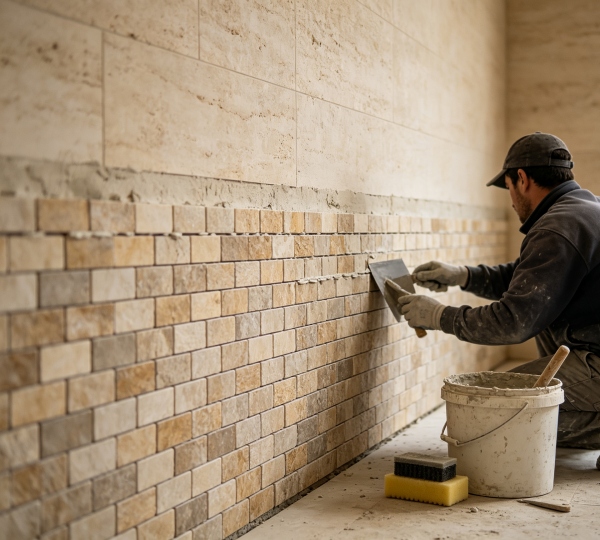
Tile failures are often described as material problems even when the real mismatch sits behind the surface. Adhesive must bond the tile to the prepared substrate, while grout must fill and protect joints under the expected moisture, movement, cleaning, and chemical exposure. Buyers get a more reliable installation when they specify these layers as one compatible system.
Tile material changes the bonding problem
Ceramic mosaic, glass, and natural stone do not present the same back surface. A porous ceramic body may absorb moisture from the setting material. Glass is dense and can reveal adhesive colour or trowel marks. Stone may react to moisture, staining, or dark adhesive depending on its composition and finish.
The first technical question is therefore not “Which adhesive is strongest?” It is “Which adhesive is compatible with this tile, backing, substrate, and exposure?” Strength without compatibility can still produce poor coverage, visible shadowing, staining, or movement failure.
Ceramic and porcelain mosaics
Small-format ceramic or porcelain mosaics create many joints and often arrive mounted on mesh. The installer needs enough open time to align sheets, enough wetting to support the pieces, and an adhesive that does not rise excessively through the joints. Backing coverage and mesh attachment should be checked on a real sheet.
Glass mosaics
Glass makes colour and coverage visible. White adhesive is commonly considered where a translucent or pale glass could reveal a darker bed, but the exact glass and adhesive manufacturer instructions should govern the choice. A mosaic and glass tile mortar system also needs confirmation for immersion, heat, exterior exposure, or other demanding conditions.
Natural stone pieces
Stone selection requires a compatibility trial because mineral composition, porosity, resin backing, mesh, and surface finish vary. Buyers should ask whether the stone is moisture-sensitive, whether a light-coloured adhesive is needed, and whether sealing or a specialist setting product is recommended.
Substrate readiness decides whether the system can work
Substrate preparation gives the adhesive a stable surface. The base should be level, dry or conditioned as required by the chosen system, solid, and free from dust, oil, grease, loose material, and other contaminants. Waterproofing, primers, membranes, and movement joints must be compatible with the setting materials.
Flatness matters especially for mosaics because small pieces follow every dip and ridge. A surface that looks acceptable for a large tile may create uneven sheet joints or variable adhesive thickness under a mosaic. Correction should happen before setting begins, not through improvised thick spots of adhesive.
Project teams should confirm these items before ordering installation materials:
- tile body, size, thickness, backing, and transparency;
- substrate type, flatness, and moisture condition;
- interior, exterior, wet, submerged, or heated exposure;
- waterproofing or membrane system;
- joint width, movement joints, and expected cleaning chemicals;
- working temperature and installer sequence.

Adhesive selection follows coverage and exposure
Adhesive choice should connect application properties to the real installation. Vertical walls may need non-sag behaviour. Large panels may need extended open time and coverage control. Pools, showers, and exteriors may need a system approved for persistent moisture, thermal cycling, or movement.
Guanyu Ceramics supplies TILE EASY Mosaic & Glass Tile Mortar model A-105 as a 20 kg product made with German-origin raw materials. It combines bonding and grouting functions and is described for tiles, mosaics, glass, and similar materials. Its documented application thickness is 1 to 5 mm per batch, with application temperature from 5°C to 40°C. But the coverage, substrate, tile backing, joint geometry, exposure, and local installation requirements should be reviewed for the exact job. The broader tile adhesive and grout range gives buyers a place to compare mortar, grout, and sealant categories without assuming one product fits every condition.
| Installation factor | Adhesive decision | Verification step |
| Translucent glass | Colour and full coverage | Build a sample board |
| Mesh-mounted mosaic | Wetting and sheet stability | Pull-test representative pieces |
| Влажная зона | Water and membrane compatibility | Confirm complete system guidance |
| Exterior wall | Movement and weather exposure | Review local method and joints |
| Natural stone | Moisture and stain sensitivity | Test with the exact stone |
Grout controls joints appearance and maintenance
Grout is both a visual material and a service layer. Colour can blend the mosaic into one field or emphasize every piece. Joint width, tile edge, surface texture, exposure, and cleaning chemicals influence whether cementitious, modified, epoxy, or another specialist grout is appropriate.
Joint geometry comes before colour
Joint width and depth determine whether a grout can be placed and finished correctly. Irregular hand-made pieces, tight glass joints, and broader floor joints may need different products. The installer should confirm that the chosen grout can fill the joint without scratching or staining the tile face.
Maintenance expectations shape the choice
Kitchens, pools, showers, food-service areas, and public washrooms face different contaminants. A premium grout may reduce staining or moisture absorption, but it can also require faster handling or more disciplined cleanup. The choice should match the contractor’s capability and the facility’s cleaning routine.
В tile grout system options from Guanyu Ceramics include grout products positioned for tile, mosaic, slab, waterproof-membrane, exterior-wall, and floor uses. Buyers should still link each product code to the exact joint, exposure, and application instructions.

A sample board aligns colour and workmanship
A sample board turns several abstract choices into one visible result. It shows adhesive colour behind glass, sheet alignment, grout shade, joint fullness, edge cleaning, and the effect of sealers or cleaners. The same installer and tools planned for the project should be used when workmanship is part of the approval.
The board should be allowed to cure under the product instructions before it is judged. Early colour can change as moisture leaves, and cleaning residue can hide the final surface. Buyers should keep an approved board or detailed photos as a reference for production and site inspection.
Packaging and shelf life protect the specified performance
Dry products and liquid components can lose reliability when storage conditions are ignored. Buyers should inspect bag or pail integrity, batch codes, manufacturing dates, shelf life, and transport protection. TILE EASY A-105 carries a stated shelf life of 12 months and should be stored dry, ventilated, cool, and protected from moisture, contamination, direct sunlight, and high temperature.
Receiving checks should separate damaged or moisture-affected packages before they reach the installer. Site teams should also prevent different product codes or batches from being mixed casually, especially where colour consistency matters.
Practical summary for a complete tile system
The correct adhesive and grout depend on tile material, backing, substrate, exposure, joint design, and maintenance. Buyers should specify the full assembly, verify compatibility, approve a representative sample board, and protect the materials through transport and storage. A matched system reduces the risk of treating every later problem as a tile defect.
For help matching mortar and grout with a mosaic, glass, ceramic, or stone programme, contact Guanyu Ceramics with tile samples, substrate details, exposure, joint size, quantities, and destination requirements.
Часто задаваемые вопросы
Can one product be used as both tile adhesive and grout?
Some products are designed for dual bonding and grouting use, including TILE EASY A-105. Suitability still depends on the exact tile, backing, substrate, joint, exposure, and instructions for the specific project.
Why is white adhesive often considered for glass mosaic?
White adhesive can reduce unwanted colour change or dark show-through behind translucent and pale glass. A sample board remains necessary because glass opacity, backing, trowel pattern, and coverage affect the final look.
Does a wet room need waterproof tile adhesive?
The complete assembly needs to manage water, including the substrate, waterproofing membrane, adhesive, grout, movement joints, and drainage. An adhesive label alone cannot replace a compatible wet-area system.
Should natural stone be sealed before grouting?
Some stone can stain or hold grout residue, while other products may not require the same treatment. Test the exact stone, grout, and proposed sealer, then follow the material and installation guidance.
How should tile mortar be stored before use?
Mortar should remain in intact packaging in a dry, ventilated, cool place, protected from moisture, contamination, sunlight, and high temperature. Site teams should also check batch information and shelf life before mixing.

наш лучший продукт
Продукт, который мы предлагаем

свяжитесь
Как мы можем Вам помочь!

наши отзывы
Что говорят о нас