
Actualités
Sintered Stone Manufacturers and Brands: A Buyer’s Guide
A showroom sample can win approval while leaving the actual slab order poorly defined. If you distribute sintered stone or buy it for contract interiors, a manufacturer’s name is only the beginning. You also need to know which collection the sample represents, what arrives on the pallet, and who will answer a fabrication question.
We recommend comparing sintered stone manufacturers and brands through those connections before comparing prices. An attractive finish has little purchasing value until you can order it precisely.
What the brand name tells you about the supply chain
A brand label on a sample box leaves a practical question unanswered: which factory makes the slab inside? We suggest asking for the factory name and exporter details on the quotation, with responsibility for the order made explicit. Keep those identities beside the product code in your purchasing record. Otherwise, a change of contact can leave your team with photographs and no reliable way to identify a repeat order.
Our export brand, Guanyu Ceramics, belongs to Foshan Guanyu Technology Co., Ltd., founded in 2001. Our business includes ceramic tiles and mosaics, with sintered stone and slabs also supplied. When you assess a fully sintered tile company, ask about the collection in front of you. A shared catalogue cover is no reason to assume shared production.
Manufacturing ownership alone does not settle suitability. An item code on the quotation gives your fabricator somewhere to begin when requesting cutting instructions. Resolve any mismatch between that code and the sample before signing the order.
A useful shortlist compares identified collections
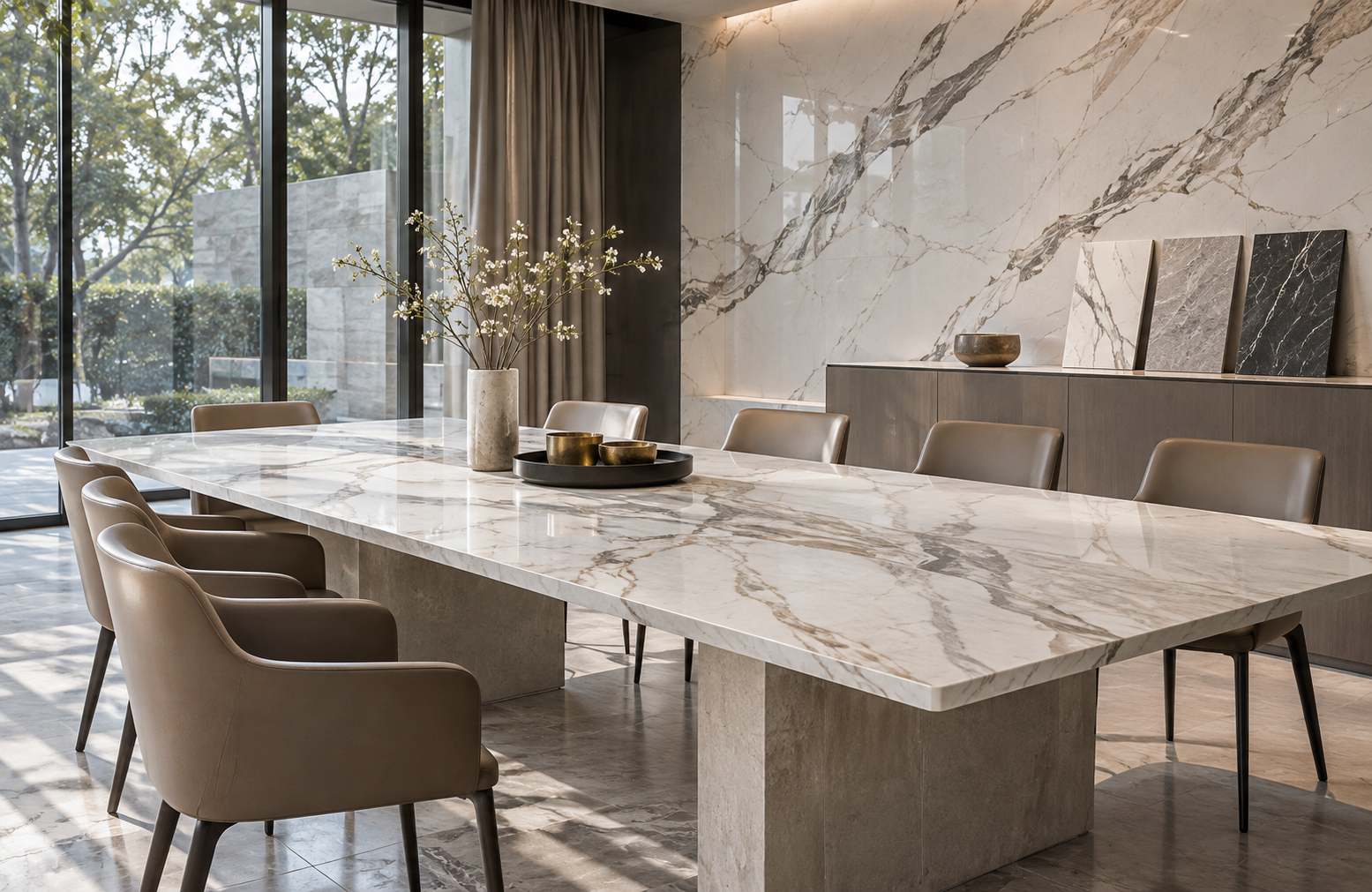
A supplier comparison becomes meaningful once each candidate quotes for the same intended work. A dining tabletop, a feature wall and a kitchen island expose different details. Choose your application first, then request the relevant format, finish and edge appearance. A general statement about strength cannot answer whether a particular design will look right after cutting.
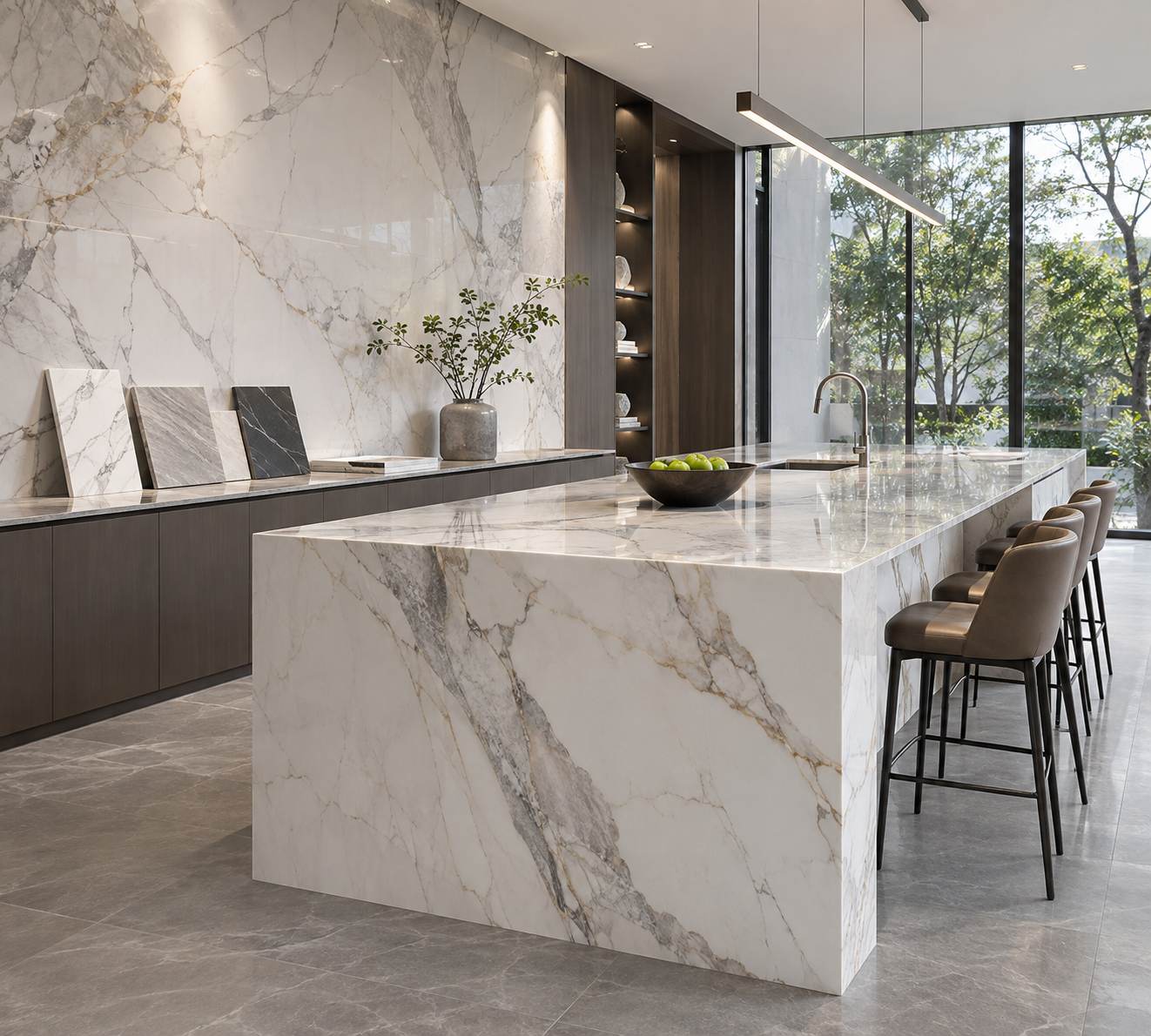
Our Luxury Marble & Quartzite Collection has a listed normal size of 1200 × 2400 × 9 mm and a micro-crystalline surface. The collection name describes a decorative direction, rather than proving that the material is quarried marble or quartzite. Keep that distinction clear in showroom labels and customer discussions.
Our through-body veining full body sintered stone range lists a satin finish and several configurations, including 1600 × 3200 × 12 mm and 1200 × 2600 × 20 mm. These are separate configurations within that range. They do not turn the 9 mm decorative collection into a 20 mm countertop product.
The dimensions affect your cutting plan before any performance comparison. A slab measuring 1200 × 2400 mm has a nominal face area of 2.88 m², calculated as 1.2 × 2.4 m. That is gross area. Edge trimming, cutouts and pattern positioning reduce the area you can use, so ask your fabricator to confirm yield from the proposed layout.
The cut edge can change your brand decision
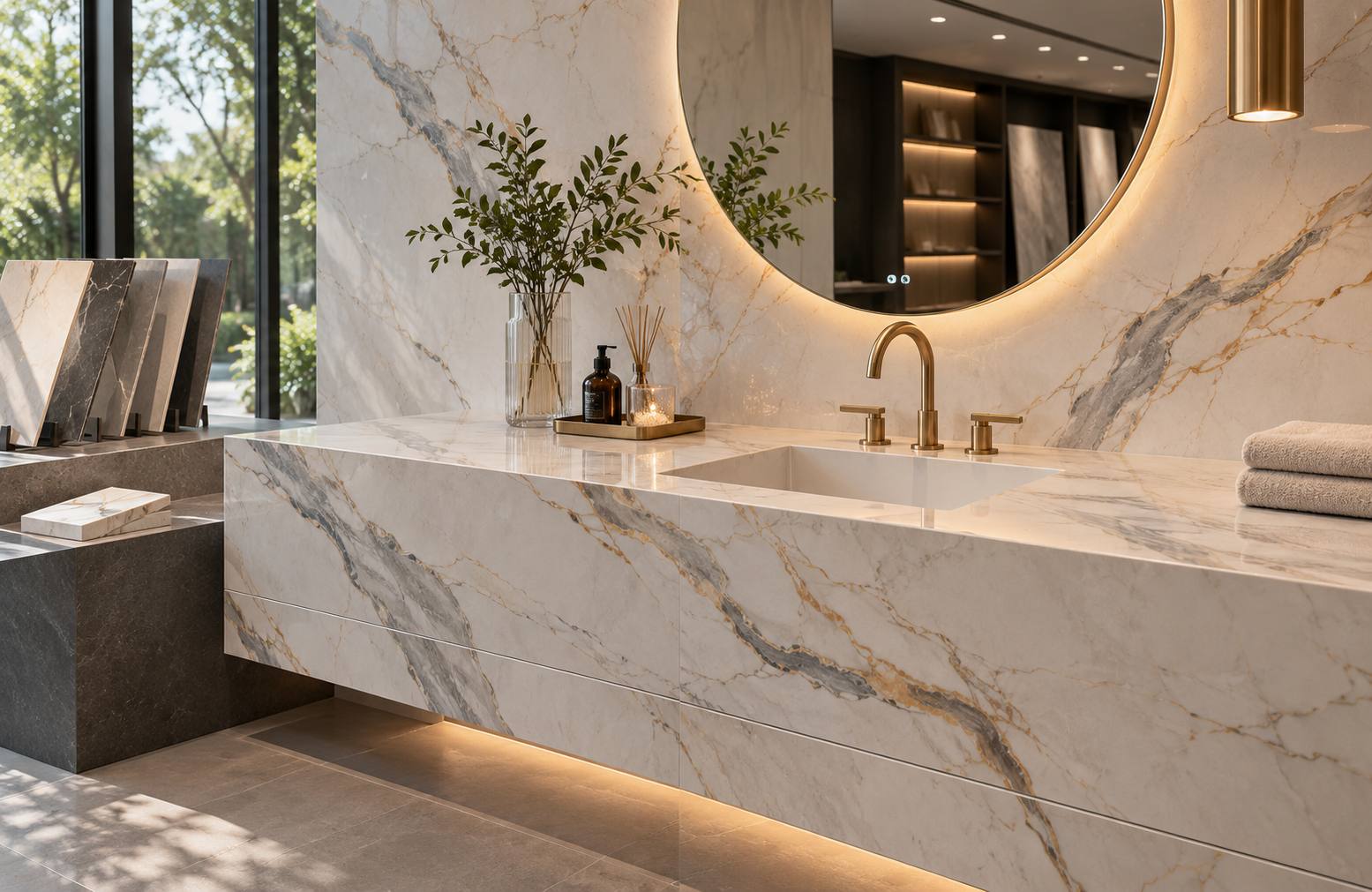
An exposed edge deserves its own sample approval. A surface photograph cannot establish how colour and veining appear through the slab thickness. For an island end or tabletop, request an offcut showing the proposed edge treatment alongside the face. Bring that offcut to the approval meeting so you can examine the edge beside the face.
The phrase through-body becomes useful when you can inspect the cut material. Ask your fournisseur de dalles de carrelage to label the offcut with its colour, thickness and edge treatment. You need the selected design here. Another colour from the same brand will leave the edge question open.
Vein continuity across adjacent pieces needs a separate layout check. A pattern that works on one panel may not produce the transition your designer expects around a corner. Ask for the slab sequence and proposed cutting positions. Approving those positions gives your fabricator a reference that a small loose sample cannot provide.
A repeat order needs more than the original quotation
A distributor’s first order creates a reference for later business. Record the collection, product code, nominal dimensions, thickness, finish and approved sample together. Write down how you will inspect the shipment and what variation your buyer has accepted. Use that record for the next purchase, because a colour name leaves too much room for misunderstanding.
When comparing fournisseurs de carreaux entièrement frittés, your packaging discussion should follow the selected format. Our through-body range lists standard pallet A-frame packing. Your warehouse still needs the shipment-specific packing details.
Before booking transport, settle the quantity per package and the unloading method with the people receiving the slabs. Get the handling instructions to that warehouse before dispatch, while there is time to resolve an equipment question.
Product claims also need collection-specific evidence. Request applicable test reports and fabrication guidance for the intended use, especially where your project requires a documented classification. A company management certificate does not establish the performance of a particular slab. Keep unsupported catalogue claims out of your own customer specification.
A brand decision you can repeat
A useful shortlist leaves you with an identifiable slab, an approved edge and a workable order record. Compare price after those details agree. Your project buyer can then approve a defined product. Your purchasing team can retrieve the same reference when a replacement is needed.
Tell us where the slab will go, the dimensions you need and the finish you have in mind. Those details give our sintered stone discussion a useful starting point before collection selection.
FAQ (questions fréquentes)
Is a sintered stone brand always the manufacturer?
A brand name alone does not establish factory ownership. Ask for the manufacturing, exporting and contracting roles for the collection you intend to purchase.
Should distributors approve only a small face sample?
A face sample helps with colour selection. For exposed edges or continuous patterns, add a processed offcut and a proposed slab layout to the approval record.
Are all Guanyu sintered stone collections the same thickness?
No. The Luxury Marble & Quartzite Collection lists 9 mm, while the through-body range includes other configurations. Confirm the selected product’s dimensions on the quotation.
Does nominal slab area equal usable cutting area?
No. Nominal area comes from the outside dimensions. Your cutting layout must also allow for trimming, cutouts and the required position of decorative veining.
What should accompany a repeat order?
Include the original product identification, approved finish and sample reference. Confirm current availability and any changes before assuming the new shipment will match your previous purchase.

notre meilleur produit
Produit que nous offrons

entrez en contact
Comment pouvons-nous vous aider !

nos témoignages
Ce qu'ils disent de notre